
There’s a Hospitality Staffing Shortage. What Now?


Key takeaways
- The hospitality staffing shortage remains one of the biggest challenges for hotels and service businesses, even years after the pandemic.
- Causes of hospitality staffing shortages include lack of flexibility, low recognition, high stress, and limited career paths.
- Businesses can navigate the hospitality labor shortage by improving retention strategies like better pay, flexible schedules, and digital tipping solutions.
- Technology like eTip helps stabilize teams by increasing take-home pay, streamlining tip management, and boosting staff satisfaction.
People are the face and the heart of hospitality — so what’s the industry to do when there just aren’t enough people?
Hotels, restaurants, and service businesses across the U.S. are facing a hospitality staffing shortage, even as guest demand climbs back to pre-pandemic levels. Housekeepers are stretched too thin, servers are juggling more tables than ever, and managers spend more time recruiting than running the business.
To overcome the hospitality labor shortage, leaders need to look beyond quick fixes and get to the root of why staffing problems persist. Let’s explore where the labor shortage came from and what your business can do to manage staffing shortages effectively and reduce turnover.
What is causing the hospitality staffing shortage?
The hospitality staffing shortage didn’t appear overnight. It’s the result of long-standing industry challenges that unfortunately collided with huge shifts brought on by the pandemic. Even five years after COVID-19 first upended travel and dining, hospitality businesses are still struggling to rebuild their workforces.
As of April 2025, the hospitality industry has the highest quit rate of any sector at 4.1% — nearly double the national average across industries. That constant churn makes hiring feel like trying to remove water from a leaky boat — no matter how many new workers come in, too many keep leaving.
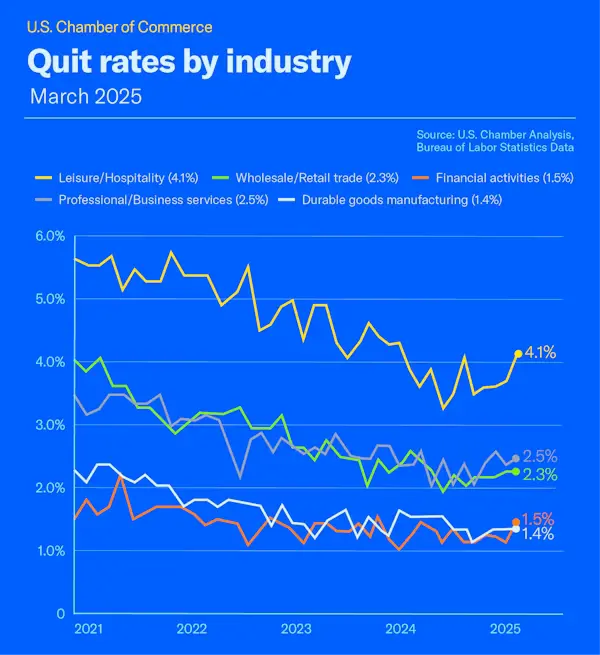
Source: US Chamber of Commerce
A pre-existing retention problem
Even before the pandemic, hospitality jobs were notorious for high turnover. Long hours, weekend shifts, and relatively low wages made it difficult to keep staff in roles for more than a year. High turnover became the norm, and many operators built business models around an endless cycle of recruiting and training.
The pandemic’s impact
COVID-19 magnified those weaknesses that the industry already struggled with.
In 2020, the hospitality industry lost nearly half of its workforce in just a few months. Many of those workers left for good, finding opportunities in logistics, healthcare, or remote work that offered more stability and better pay.
By 2025, travel and dining demand has rebounded — but the workforce hasn’t returned at the same pace. As AHLA President & CEO Rosanna Maietta explained in February 2025, “American hotels have largely recovered from the pandemic, [but] hotel employment is still nearly 10% below pre-pandemic staffing levels.”
Changing worker expectations
These days, employees across the board expect more from their employers. They’re increasingly demanding things like flexible scheduling, mental health support, career development, and competitive pay. The hospitality industry has been slow to meet those demands, leaving workers feeling undervalued and quick to jump ship.
To combat shortages, hotels and restaurants have boosted pay and added perks. Yet even with these incentives, staffing remains tight.
Why?
Because higher wages alone don’t fix the deeper issues of unpredictable schedules, lack of recognition, and limited growth opportunities.
Where are hospitality staffing shortages most pronounced?
The labor shortage in the hospitality industry varies widely across sectors — and even more so by geography.
- Hotels
Hotels remain critically understaffed. In early 2025, 65 % of U.S. properties were short-staffed, with 9% calling their staffing crisis “severe.”
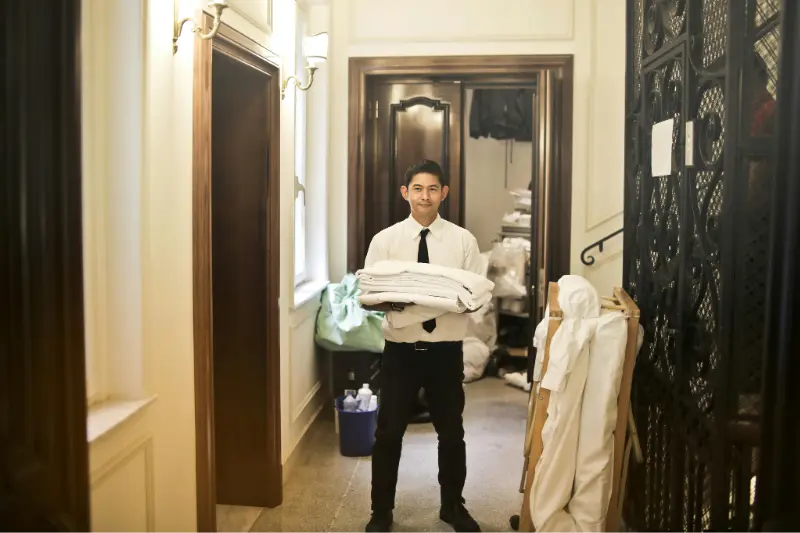
- Operators report that the biggest hotel staffing shortages are in housekeeping, followed by front desk, culinary staff, and maintenance.
- Operators report that the biggest hotel staffing shortages are in housekeeping, followed by front desk, culinary staff, and maintenance.
- Restaurants
45% of restaurants report being understaffed.
- A report backed by the James Beard Foundation notes that restaurateurs expect staffing shortages to be one of their three biggest concerns in 2025.
- A report backed by the James Beard Foundation notes that restaurateurs expect staffing shortages to be one of their three biggest concerns in 2025.
Geographically, big cities are feeling hospitality staffing shortages the hardest. In dense urban centers, hospitality jobs still lag well behind recovery levels, thanks to slower foot traffic and weaker demand. Meanwhile, suburban and rural areas have been quicker to bounce back.
Understanding hospitality’s staff retention problems
High turnover continues to be one of hospitality’s biggest challenges. Even when roles are filled, many employees don’t stay long enough to create stability.
There are a few key factors that keep this revolving door spinning:
Lack of flexibility
Hospitality jobs tend to require nights, weekends, and holidays, leaving little space for personal commitments. Workers who can’t shape their schedules around family or education are more likely to move on quickly.
Lackluster recognition
Despite the physical and emotional demands of hospitality work, many employees feel like it’s a thankless job. Guest satisfaction often overshadows staff contributions, and without consistent recognition, workers lose motivation to stay.
High stress
Hotels, restaurants, and service businesses are undeniably fast-paced. Long shifts, impatient guests, and unpredictable workloads create constant pressure. When staffing levels are already down, that pressure intensifies and burnout sets in fast.
Limited growth opportunities
A lot of hospitality workers feel like they’re in dead-end jobs. There’s no room for growth, and limited chances for even a small promotion. Without clear training paths, mentorship, or opportunities for advancement, employees see their jobs as temporary rather than as viable long-term careers.
How to navigate hospitality staff shortages
If you own or manage a hotel, restaurant, tour company, or other hospitality business, chances are you’ve been understaffed at some point. If you’re battling a period of low staffing right now, here’s what you can do to maintain excellent service while limiting the pressure your staff feels.
Expand recruiting channels
Simply posting on job boards won’t cut it.
You can widen your reach by tapping into local:
- Community colleges
- Vocational schools
- Workforce development programs
Partnerships with nonprofits, veteran groups, or immigrant support organizations can also connect you with motivated workers who you wouldn’t have otherwise reached with a quick listing on Indeed.
Strengthen your referral pipeline
Your employees might have friends, family, or former colleagues who would be a good fit. Offer a referral bonus to sweeten the deal.
Cross-train existing staff
Training employees to cover multiple roles — such as front desk staff who can also help with basic housekeeping, or restaurant servers who can assist with to-go orders — ensures that critical tasks don’t fall through the cracks.
Manage guest expectations
Transparency goes a long way. Let guests know when wait times might be longer or when certain services are limited because you’re short-staffed.
Tips to retain hospitality staff longer
Losing employees and training new ones isn’t just frustrating — it’s also expensive. Employee retention should be a priority for any hospitality owner or operator.
Here are the best strategies to hold onto your best people:
Reassess compensation packages
First off, if our wages don’t match (or beat) nearby competitors, you’ll always struggle to keep talent.
But competitive pay is just the beginning.
You should also consider adding small but meaningful perks — like additional paid time off, wellness stipends, or transportation assistance. These additions to an employee’s total compensation package can be enough to prevent them from looking for something better elsewhere.
Adopt a digital tipping solution
Tipping is one of the fastest ways to boost hospitality employees’ income without impacting payroll. And accepting digital tips is the best way to help staff get larger and more frequent tips.
Just as important, a digital tipping system makes sure employees get their tip payouts quickly. It also builds trust with employees that tips are split and paid out fairly, because they can see a dashboard of their own tip earnings from an app.

Embrace flexibility
Hospitality’s rigid schedules are one of its biggest turn-offs to employees who crave a solid work-life balance.
Consider offering options like:
- Split shifts
- Rotating weekends off
- Self-scheduling tools
Invest in employee development
Retention improves when employees see a future with your business.
Offer access to training programs, online learning, or mentorship to show staff you’re invested in their growth. And establish clear promotion paths to not only encourage people to stay but also to build a stronger internal pipeline for management roles.
Automate processes
Manual, repetitive tasks are a major source of frustration for hospitality staff. Automating functions like check-in, scheduling, or tip distribution gives staff more time to focus on guests and less time bogged down in paperwork.
How digital tipping boosts hospitality staff retention
Hospitality staffing shortages usually come down to one thing: compensation.
Staff want to know they’ll be rewarded fairly for their work, and they don’t want to wait weeks to see those earnings.
Digital tipping is the easiest way to maximize your employees’ income and keep them around longer without inflating your payroll.
When tips are easy to give and fast to receive, employees feel the difference immediately. They see a steady stream of extra income, they know payouts are accurate, and they gain control over when they get paid.
Higher, more predictable take-home pay quickly becomes one of the strongest reasons employees choose to stay.

Use eTip to retain employees longer
eTip is the #1 digital tipping platform for hotels, restaurants, and other hospitality businesses.
Businesses using eTip report:
- A 5x increase in tip frequency
- Up to a $5 boost in hourly income
- As much as a 30% lift in retention rates
Unlike other platforms, eTip doesn’t put barriers in front of staff. Every employee is approved, every payout is seamless, and every property benefits from happier, more loyal staff.
See what eTip could look like in your hotel, restaurant, or business. Schedule a demo today!
![[CTA] Image - Retention 4 - 1200 x 627](https://no-cache.hubspot.com/cta/default/6775923/interactive-190476979895.png)
Join the eTip community!
We'll send the latest content & special releases directly to your inbox.
Ready to join the community?
Receive the latest & greatest content from eTip, sent directly to your preferred inbox!